



Theories
Through the 20th century a new type of philosophy and social theory has emerged.
These tendencies, instead of focusing on the logos of truth, focus on the health of
modern society through a socioeconomic perspective. We'll go through some of these ideas,
interpret them, and then analyze their veracity in the real world.
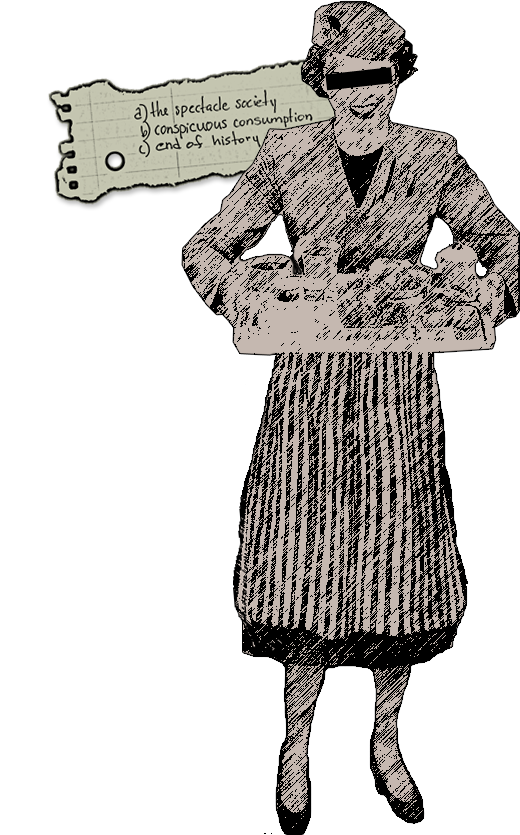
Thorstein Veblen, an American economist, introduces the term conspicuous consumption
to the world in his book The Theory of the Leisure Class. He calls this phenomenon the
consumption of expensive goods for the sake of showing social status. He argues that
economics aren't driven by notions of utility, but by the pursuit of higher hierarchy.
Guy Debord wrote on 1967 The Society of the Spectacle. In it he goes through the anatomy of a
society that's focused on consuming representations of representations, until the original object
would become forgotten. In a society of spectacle the production of consumable products is the final
mean of existence itself. Being passive is awarded in this type of society, as the person accumulates
spectacles. Everything that used to be lived becomes a simulacrum. The spectacle is justified as a
means to unify society.
Jean Baudrillard would argue that a society that lived to consume would enter a state of hyperreality. This state
is one in which signs of value would overcome the real experience. Relationships become less significant, and intense
feelings are experienced and terminated quickly. Stimuli upon stimuli is said to desensitize the individual without him
ever noticing.
One of Baudrillard's arguments that would seem most critical is the termination of history. The world has
reached a state of apparent completion. There's no more opposition, "democracy" has been achieved. Nothing
new exists, and the only thing to be found in this homogeneous world is the acceleration of images that
turn repetitive and numbing. The universe becomes a collage of the official history, and the only thing
that keeps changing is the reordering of the repeated objects.